Ten years ago, I contacted a tree that was copying my records. If you use Ancestry.com, then you know what I am talking about. This was a method of mine to hopefully find more information for my tree — to collaborate. I never thought Stevie — my nickname for him, like when kids knock on a door and say, “Stevie, can you come out and play?” In today’s world, it’s more like sending an IM: “Are you ready to chat?” — would end up being a cousin, that I would gain a new family member, and now have to say goodbye.
Contacting a Tree
Before starting this post, I was wondering how long I had known Stevie. I remembered my grandson was small — after checking my Ancestry messages, I discovered it was close to Thanksgiving 2015. Stevie responded quickly to my message.
I am amazed that Ancestry has stored the messages this long. As we worked on exactly where our connection was located, we bonded, and by January 2016 we took our “10th cousiness” to the next level and became Facebook friends, where we instant messaged and used the calling feature occasionally. Because of the time zone difference, we messaged early in the morning before I went to work, as my routine was being up by 5 a.m. to work on my tree before leaving for work. This worked out great. When I retired, we kept that routine, but now I could call even more, as work wasn’t getting in the way.
Talking, Trusting, and Becoming Family
In the beginning of IM’ing, we were both careful not to give too much personal information until we each felt comfortable and trusted that this was real and not some sort of scam. In these days you can never be too careful.
We shared about our families, and he watched my grandson grow from a baby into a 6th grader. One thing we loved to do was share photos of what we were eating. The last food photo I sent him was my Christmas Day dinner — something new for me. Instead of the usual standing rib roast with all the trimmings, including Yorkshire puddings, I made pot roast with veggies, gravy, and Yorkshire puddings. He, of course, would send me photos of his meals, which always seemed to include “spuds,” as he called them.
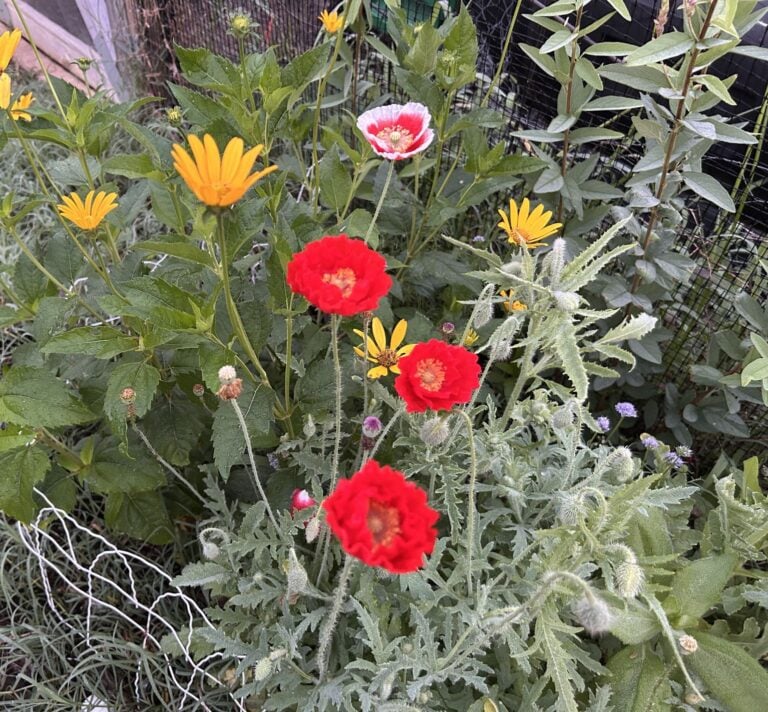
As our friendship grew, it moved beyond messages. We mailed things to each other — I sent him my homemade Christmas cookies, and he sent me poppy seeds from his garden. Those poppies bloomed last year, and I’ve already expanded them to another spot in the pickle patch. I’m hoping for even more this year, and when they bloom, I’ll add them to his page in my tree. It feels right that something he grew is now growing here.
As we talked more, the conversations shifted from light updates to the things you only share with someone you trust. I learned his sister was sick and on hospice, and when she passed, he called me. That moment changed something. He didn’t have to tell me — but he chose to. My family knew that whenever I took a photo of food, it was going straight to Stevie. They all knew of him, even though they never talked to him, and Stevie knew all of them because that’s what you do — you share your life with family, including the hard parts.
Then one day he told me to look at his DNA matches, and that took us on a wild genealogy mystery ride.
Wild Genealogy Mystery Ride
Now that we trusted each other, we shared our trees fully. He even made me an editor on his. He loved that I could go to the FamilySearch Center and pull the parish records for his ancestors. I would add them to my tree so he could copy them directly into his. Doing it this way meant we weren’t making mistakes or chasing the wrong lines.
Then one day, out of the blue, he asked me to look at his new DNA cousins. I checked immediately and looked at the total centimorgans for the two closest matches. Based on the numbers, I called Stevie and said, “You have two half‑sisters.” He insisted he didn’t know of any half‑siblings.
I started examining the shared cousins and building a separate tree just to keep everything straight. Meanwhile, we each tried contacting the new half‑sisters. One responded right away, but the other took several weeks — and she turned out to be the key that finally unlocked the mystery.
From the first half‑sister, we learned that their father had been in the military during World War II and served in the RAF in Scotland. The Scotland cousin had been adopted and knew nothing about her bio father, but she did have her mother’s information — one of the reasons she took the DNA test. One thing we could rule out was Stevie’s father; he had been in the merchant navy and was never stationed in Scotland.
Then Stevie told me something important: his mother had kept a photo of a man in an RAF uniform. The name on the back said he was her cousin’s boyfriend. Suddenly we had a real lead — a name. With that, we dug deeper and uncovered a surprising amount of information about the “potential” biological father. With all the clues, we were confident we had the right man even before the second half‑sister confirmed it after seeing Stevie’s photo.
Stevie wasn’t upset. He still considered the man who raised him to be his father. But now he had three living half‑sisters — and one half‑brother who had died young. At that time, he was the last surviving member of his immediate family. Now he had sisters again. They met only once, but they stayed in touch by phone and messages.
As we worked on his new biological father’s tree, we discovered that his bio‑dad didn’t know his own father and had used his mother’s surname. That explained why the DNA cousins matched the way they did. We were even able to narrow down the possible father for his bio‑dad. Maybe one day I’ll be able to say for certain. All it takes is one more hint. It’s just too bad the answer didn’t come before Stevie’s death.
Those were good days — and I didn’t realize how quickly things would shift.
His Decline
His decline started about a year before his death. At first it was subtle — shorter messages, conversations that drifted toward the weather, and a gradual quietness that felt different from his usual self. I tried to draw him out, but he didn’t seem able to talk the way he used to. About six months before he passed, he developed a cough that never really went away. That’s when I started calling him more often. One morning he told me he was waiting for “the paramedic.” When I asked how long he had been waiting, he said a couple of hours. I later learned that in his area this meant a doctor doing house calls in his own car — not the emergency response we think of in the U.S. He said the doctor prescribed several medications.
He told me he had scans and that it wasn’t cancer. He mentioned taking heart medicine at one point, but he never went into detail. I didn’t push him. I thought it was something simple, like the medication my dad once took.
About a month before his death, the messages stopped. He also stopped playing our daily game of Words With Friends. I assumed he just wasn’t feeling up to it and didn’t want to bother him.
The last time I spoke to Stevie was on Boxing Day, December 26th. He wasn’t going to his neighbor’s this year, so I asked what he had ordered from the grocery. He always had his Saturday food delivery. He told me my Christmas dinner looked delicious and that I finally had the Yorkshire puddings “down pat.” He told me I needed to try the frozen ones — five minutes in the oven and done. I told him we don’t have Yorkies in our U.S. stores. Our call ended when his neighbor came by to visit.
Saying Goodbye
A few days later, on New Year’s Eve, I sent him a photo of me standing in front of my newly planted blueberry bushes (my twigs) in the Pickle Patch, wishing him a Happy New Year.
On January 2nd, I started calling at precisely 6:19 a.m. and tried almost every hour. By the third call, I knew something was wrong. I wondered if he was in the hospital.
I reached out to his half‑sister, and I could tell it was difficult for her to respond — several minutes passed before she IM’ed me back. When her message finally appeared, it read, ‘I am sorry to have to tell you Steve passed away on the 1st of January.’
If I hadn’t had her contact information, I would never have known. I suppose I would have eventually gone to his Facebook page and contacted his cousin. It’s something to think about with long‑distance or “new age” relationships — how easily someone can disappear from your daily life without anyone knowing to tell you.
The only regret I have is not planning a trip sooner to see him. He never traveled out of the UK and had never been on an airplane. I would have loved for him to have visited us. Our trip to meet him was supposed to be this year. Instead, it will have to be a tribute — eating his favorite fish and chips, or perhaps his spuds and mushy peas.
What I will miss the most is our daily messaging, the photos and videos we shared, and our phone calls. You entered my life on a genealogy quest to collaborate. On paper we are 10th cousins once removed, but sometimes we choose our family — and Stevie was mine.